Every founder wants growth.
After securing early customers and gaining momentum, it's natural to think the next step is increasing the marketing budget, hiring an agency, or launching new acquisition channels.
But scaling marketing before your business is ready can be one of the most expensive mistakes a startup makes.
More advertising won't fix poor positioning.
Publishing more content won't solve weak conversion rates.
Adding new channels won't help if you can't identify where your best customers come from.
Growth doesn't fail because startups market too little; it often fails because they scale before building the systems needed to support sustainable customer acquisition.
This is where a startup marketing audit becomes invaluable.
Rather than asking, "How can we grow faster?", a marketing audit asks:
- Are we attracting the right customers?
- Can we measure what's working?
- Is our website converting visitors?
- Have we proven our acquisition channels?
- Are we ready to scale confidently?
If the answer to any of these questions is "not yet," your focus should be on strengthening your marketing foundation before increasing investment.
In this article, we'll explore the ten most common signs that a startup isn't ready to scale marketing, and what you should build first to create sustainable, evidence-based growth.
Why Timing Matters in Startup Growth
Scaling is exciting, but timing matters.
Many founders assume that increasing marketing activity will naturally produce more customers.
Unfortunately, scaling often magnifies existing weaknesses rather than solving them.
Imagine pouring more water into a leaking bucket.
No matter how much you add, you'll continue losing valuable resources.
Marketing works the same way.
If your positioning is unclear, your website converts poorly, or your reporting is incomplete, increasing your marketing budget simply amplifies those problems.
Successful startups don't rush into scaling.
They first validate that their marketing foundations are strong enough to support increased investment.
That means having:
- Clear positioning
- Consistent messaging
- Reliable conversion paths
- Accurate tracking
- Repeatable customer acquisition
- Meaningful performance data
Once these elements are in place, scaling becomes far less risky and far more predictable.
10 Signs You're Not Ready to Scale
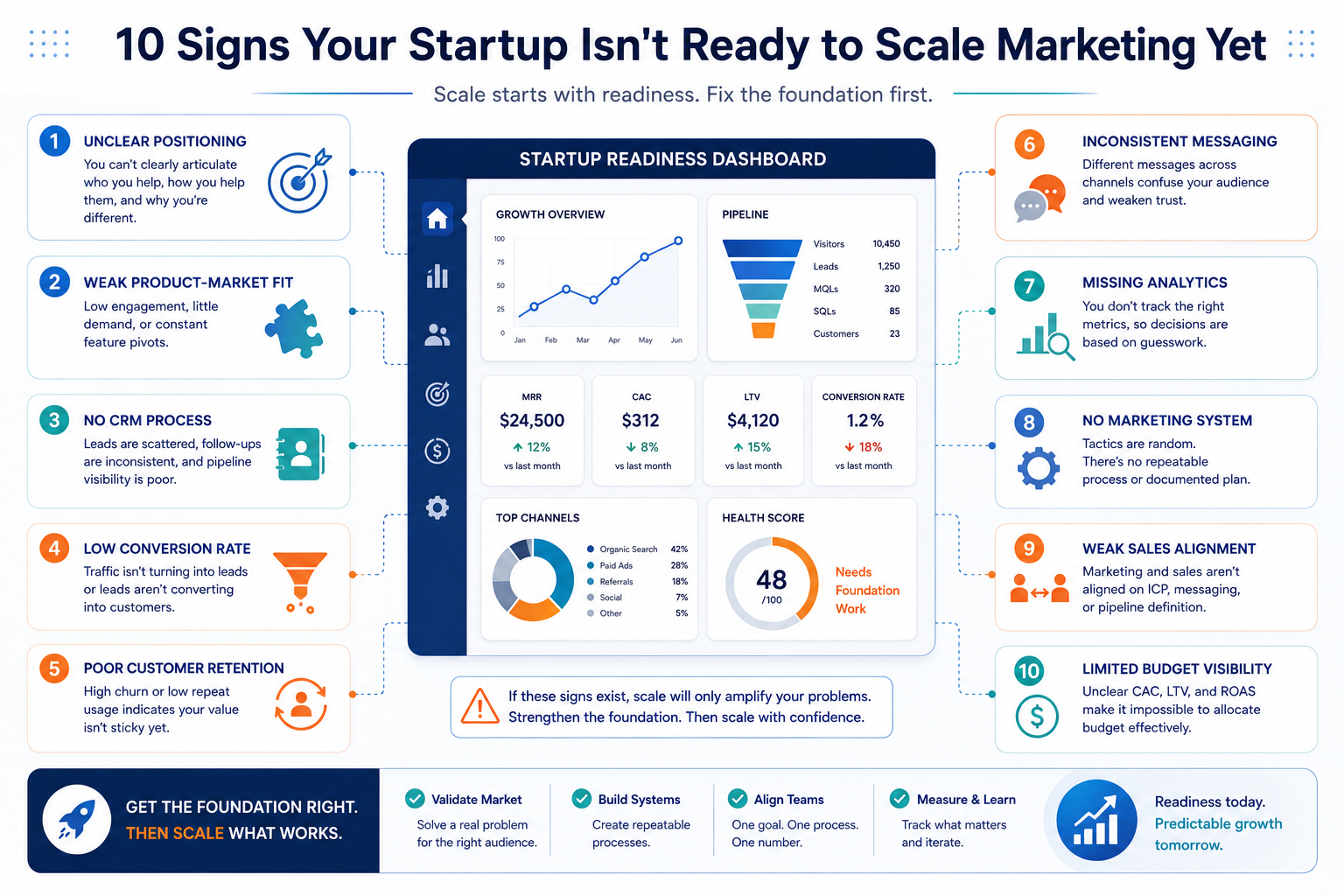
Recognising these warning signs early can save your startup significant time, money, and frustration.
If several of these apply to your business, it may be time to pause expansion and strengthen your marketing system first.
1. You Don't Know Your Customer Acquisition Cost (CAC)
One of the clearest signs your startup isn't ready to scale is not knowing how much it costs to acquire a customer.
Customer Acquisition Cost (CAC) measures the average amount your business spends to gain one new customer.
Without this metric, it's impossible to answer important questions such as:
- Is our marketing profitable?
- Which channels deliver the best return?
- Can we afford to increase our marketing budget?
Scaling without understanding CAC often leads to overspending and declining profitability.
Before increasing investment, founders should establish accurate cost tracking across every acquisition channel.
2. Your Website Doesn't Convert
Generating more website traffic isn't useful if visitors leave without taking action.
Many startups invest heavily in advertising or SEO while overlooking the website experience.
Warning signs include:
- Low enquiry rates
- High bounce rates
- Poor landing page performance
- Confusing navigation
- Weak calls to action
- Slow loading times
Your website should function as your highest-performing sales asset, not simply an online brochure.
Optimising conversions before increasing traffic usually produces stronger returns than expanding marketing budgets.
3. Tracking Is Incomplete
You can't improve what you can't measure.
Unfortunately, many startups collect only partial marketing data.
They may know how many visitors reached the website, but not:
- Which campaign generated the lead
- Which content influenced conversion
- Which acquisition channel produced revenue
- Where prospects abandoned the buying journey
Without complete tracking, founders make decisions using assumptions instead of evidence.
A marketing system should include:
- Website analytics
- Conversion tracking
- CRM integration
- Attribution reporting
- Customer journey measurement
Reliable data provides the confidence needed for sustainable scaling.
4. Your Messaging Changes Every Month
Early-stage startups naturally evolve.
Products improve.
Markets shift.
Customer feedback introduces new ideas.
However, constantly changing your marketing message creates confusion.
If your homepage says one thing, your LinkedIn profile says another, and your sales team communicates something different again, prospects struggle to understand your value.
Strong messaging should remain consistent while evolving thoughtfully over time.
A startup that's still redefining its value proposition every few weeks should focus on refining its positioning before increasing marketing investment.
5. You're Relying on One Founder for Sales
Many founder-led startups depend heavily on the founder to explain the product, build trust, and close every deal.
While this approach often works in the early stages, it becomes difficult to scale.
Ask yourself:
- Can prospects understand our value without speaking to the founder?
- Is our messaging documented?
- Could another team member confidently deliver the same sales conversation?
If the answer is no, your marketing system still depends on individual expertise rather than repeatable processes.
Scalable marketing captures the founder's knowledge and turns it into consistent messaging across the website, content, sales materials, and customer journey.
6. You Don't Know Where Your Leads Come From
Generating leads is only part of the equation.
To make smart marketing decisions, you also need to understand exactly how those leads found your business.
Many startups collect enquiries through contact forms or demo requests, but can't answer questions like:
- Which marketing channel generated this lead?
- Which blog post influenced the enquiry?
- Did they first discover us through organic search, paid advertising, LinkedIn, or a referral?
- Which campaigns produce our highest-value customers?
Without attribution, marketing budgets are often allocated based on assumptions rather than performance.
For example, you may believe paid advertising is driving growth because it generates the most leads. However, detailed attribution might reveal that organic search consistently produces customers with a much higher lifetime value.
Understanding lead sources helps founders:
- Invest in the highest-performing channels
- Reduce wasted marketing spend
- Improve forecasting
- Optimise customer acquisition
Before scaling, every startup should have reliable lead source tracking in place.
7. Your Marketing Channels Compete With Each Other
Marketing works best when every channel supports the same customer journey.
Unfortunately, many startups treat each channel as an independent project.
SEO targets one audience.
Paid advertising promotes different messaging.
Social media focuses on unrelated topics.
Email campaigns send inconsistent offers.
Instead of working together, each channel competes for attention.
This creates a fragmented customer experience and makes it harder for prospects to understand your value.
A marketing operating system ensures every channel supports the same positioning, messaging, and business objectives.
Whether someone discovers your company through Google, LinkedIn, email, or referrals, they should experience one consistent brand story.
8. You Haven't Proven One Channel Yet
A common mistake among growing startups is trying to expand into multiple acquisition channels before mastering one.
You might be running:
- Google Ads
- LinkedIn Ads
- Facebook Ads
- SEO
- Email marketing
- Podcasts
- Webinars
- Partnerships
While diversification has its place, spreading limited resources across too many channels often reduces overall performance.
Instead, successful startups validate one acquisition channel first.
They measure:
- Lead quality
- Conversion rates
- Customer Acquisition Cost (CAC)
- Return on Marketing Investment (ROMI)
- Revenue attribution
Once that channel consistently delivers profitable results, additional channels can be introduced strategically.
Scaling becomes far less risky because it's based on proven performance.
9. You're Making Decisions From Opinions Instead of Data
Every founder has instincts.
Those instincts are valuable, particularly during the early stages of building a company.
However, as marketing investment grows, relying solely on opinions becomes increasingly expensive.
Examples include:
- "Let's try this because our competitor is doing it."
- "I think this campaign worked."
- "We should double the budget."
Instead, evidence-based businesses ask:
- What do the numbers show?
- Which channels are improving profitability?
- Where are prospects leaving the funnel?
- Which marketing investments create measurable business outcomes?
Data doesn't eliminate creativity; it strengthens decision-making.
When marketing decisions are supported by reliable evidence, startups reduce unnecessary risk while increasing confidence.
10. You Don't Have Repeatable Customer Acquisition
The final, and perhaps most important, sign is inconsistency.
Some months produce outstanding results.
Other months produce almost none.
If customer acquisition depends on:
- Founder networking
- One successful campaign
- Word of mouth
- Random referrals
- Occasional paid advertising success
Your business doesn't yet have a repeatable growth engine.
Repeatable customer acquisition means your startup has a documented process for attracting, converting, and retaining customers consistently.
When acquisition becomes predictable, scaling becomes much easier.
What You Should Build Before Scaling

Alt text: Founder reviewing marketing automation workflow before scaling business growth.
Rather than increasing marketing budgets immediately, startups should first strengthen the foundations that support sustainable growth.
These building blocks reduce risk while improving the effectiveness of every future marketing investment.
Positioning
Everything begins with positioning.
Your business should clearly communicate:
- Who you help
- What problem do you solve
- Why are you different
- Why customers should trust you
Strong positioning improves every marketing channel because it creates consistency across your website, advertising, content, and sales conversations.
Without it, marketing efforts often become fragmented and less effective.
Conversion
Before driving additional traffic, ensure your website converts visitors into qualified leads.
Key areas to optimise include:
- Landing pages
- Calls to action
- Navigation
- Mobile usability
- Lead capture forms
- Trust signals
- Social proof
Improving conversion rates often delivers faster returns than increasing traffic alone.
Tracking
Scaling requires visibility.
Every startup should implement reliable tracking that measures:
- Website behaviour
- Lead generation
- Conversion events
- Customer acquisition
- Revenue attribution
Accurate tracking removes guesswork and allows founders to invest confidently in the channels that consistently perform well.
Attribution
Attribution connects marketing activity to business outcomes.
Instead of simply counting leads, attribution helps answer:
- Which channels generate revenue?
- Which campaigns influence buying decisions?
- Where should future investment go?
This visibility allows businesses to optimise marketing spend while improving overall efficiency.
Funnel
Customer acquisition doesn't end when someone visits your website.
A strong marketing funnel guides prospects through every stage of the buying journey:
- Awareness
- Interest
- Consideration
- Decision
- Purchase
- Retention
- Advocacy
Each stage should support the next, creating a seamless experience that increases both conversions and customer lifetime value.
Automation
As your startup grows, manual processes become increasingly difficult to manage.
Automation helps maintain consistency while reducing repetitive work.
Examples include:
- Lead nurturing emails
- CRM updates
- Customer onboarding
- Internal notifications
- Lead scoring
- Reporting dashboards
Automation should enhance proven processes, not replace strategic thinking.
When implemented correctly, it allows startups to scale efficiently without sacrificing customer experience.
How The Corient System™ Helps Startups Prepare for Growth
At Corient, we believe that successful marketing isn't built by running more campaigns; it's built by creating a repeatable system that enables smarter decisions, stronger execution, and sustainable growth.
That's why we developed The Corient System™, an evidence-based marketing operating system specifically designed for founder-led startups.
Rather than relying on assumptions or chasing the latest marketing trend, The Corient System™ helps businesses establish the right foundations before scaling customer acquisition.
Our methodology follows three simple but powerful stages:
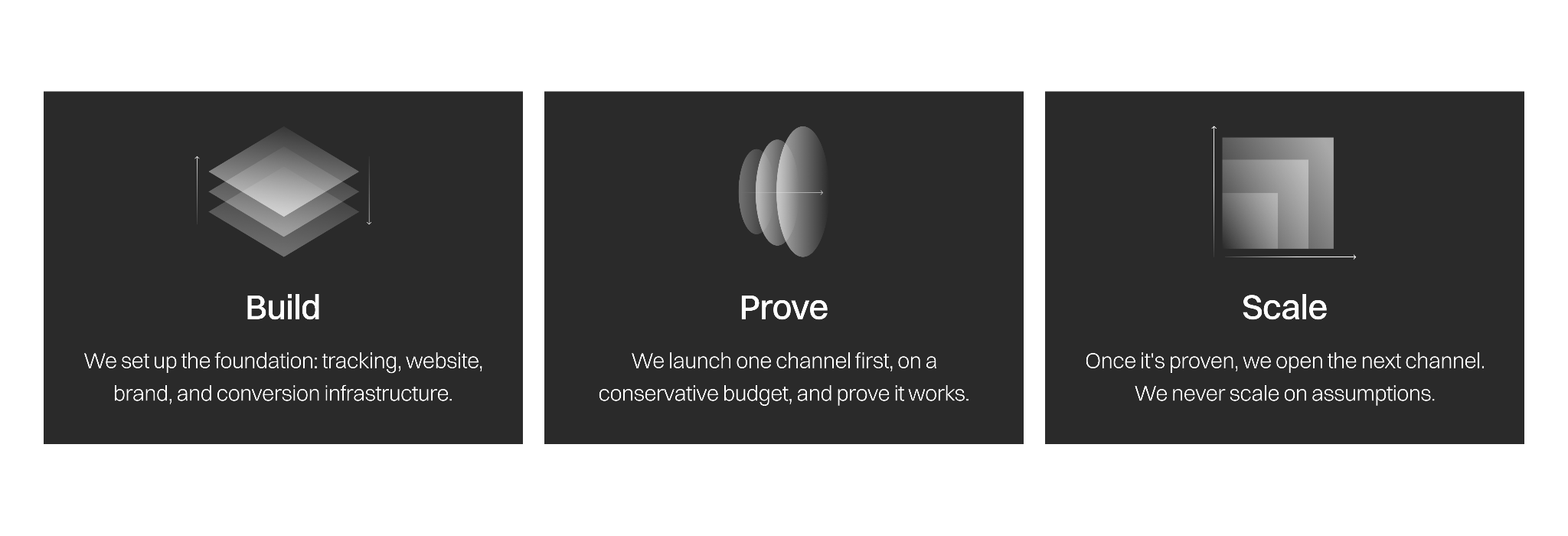
Build
Every successful startup begins with a solid foundation.
During the Build phase, we work with founders to create the infrastructure that supports long-term growth.
This includes:
- Clarifying positioning and messaging
- Defining the Ideal Customer Profile (ICP)
- Optimising the website for conversions
- Mapping the customer journey
- Setting up analytics and attribution
- Building reporting dashboards
- Aligning marketing with business objectives
Many startups skip these fundamentals in favour of launching campaigns quickly. However, without strong foundations, even the best campaigns struggle to produce consistent results.
The Build phase ensures your marketing is ready before additional investment is made.
Prove
Once the foundation is established, the next step is validation.
Instead of spreading resources across multiple channels, we focus on identifying and proving one acquisition channel that consistently delivers measurable business outcomes.
During this stage, we monitor metrics such as:
- Customer Acquisition Cost (CAC)
- Conversion rates
- Qualified leads
- Sales pipeline growth
- Revenue attribution
- Return on Marketing Investment (ROMI)
The objective isn't simply to generate results once; it's to demonstrate that those results can be repeated consistently.
Only after reliable performance has been established do we recommend expanding investment.
Scale
Scaling should be intentional, not impulsive.
During the Scale phase, startups increase marketing investment only after proven success.
This may involve:
- Expanding paid advertising
- Growing SEO and content marketing
- Launching lifecycle marketing campaigns
- Implementing marketing automation
- Introducing additional acquisition channels
- Strengthening customer retention initiatives
Because every decision is supported by measurable data, growth becomes more predictable, efficient, and sustainable.
Instead of reacting to market trends, founder-led startups scale with confidence.
Startup Marketing Readiness Checklist
Before increasing your marketing budget, ask yourself the following questions.
If you answer "No" to several of these, your startup will likely benefit from strengthening its marketing foundations first.
Positioning
- Do we clearly define our ideal customer?
- Can we explain our unique value proposition in one sentence?
- Is our messaging consistent across every channel?
Website & Conversion
- Does our website clearly communicate our value?
- Are visitors converting into qualified leads?
- Do we have strong calls to action throughout the customer journey?
Tracking & Attribution
- Can we accurately track where every lead comes from?
- Do we know our Customer Acquisition Cost (CAC)?
- Can we connect marketing activity to revenue?
Customer Journey
- Have we mapped the complete customer journey?
- Do prospects receive the right information at each stage?
- Are customers nurtured after becoming leads?
Marketing Channels
- Have we proven at least one acquisition channel?
- Do all marketing channels support the same positioning?
- Are we investing based on evidence rather than assumptions?
Automation & Systems
- Are repetitive marketing tasks automated?
- Are our marketing processes documented?
- Can marketing operate effectively without founder involvement in every decision?
Frequently Asked Questions
When should startups scale marketing?
Startups should scale marketing only after they have validated that their positioning, messaging, website, tracking, and customer acquisition process consistently produce measurable results. Scaling before these foundations are established often leads to higher costs and lower returns.
What should startups measure first?
Before increasing marketing investment, startups should focus on metrics that directly influence business performance, including Customer Acquisition Cost (CAC), conversion rates, qualified leads, revenue attribution, customer lifetime value (LTV), and return on marketing investment (ROMI).
What is marketing readiness?
Marketing readiness refers to how prepared a business is to increase marketing investment successfully. It includes having clear positioning, consistent messaging, reliable tracking, a high-converting website, and at least one validated customer acquisition channel.
Why is attribution important?
Attribution helps businesses understand which marketing activities contribute to leads, sales, and revenue. Without attribution, founders often invest in channels based on assumptions rather than measurable performance, making it harder to scale efficiently.
Final Thoughts
Scaling marketing is an exciting milestone, but it should never be the first step.
The startups that achieve sustainable growth don't simply spend more on advertising or launch more campaigns. They build the systems that allow every marketing investment to work harder.
By taking the time to strengthen positioning, optimise conversions, implement accurate tracking, and validate customer acquisition channels, founder-led businesses create a solid foundation for long-term success.
A startup marketing audit isn't about identifying what's wrong; it's about understanding what's needed before scaling confidently.
When the fundamentals are in place, marketing becomes more predictable, more measurable, and far more effective.
Not sure if your startup is truly ready to scale?
Corient helps founder-led startups assess their marketing readiness through our evidence-based Build → Prove → Scale methodology. We'll help you identify growth bottlenecks, strengthen your marketing foundations, and create a repeatable system that supports sustainable business growth.
Book a Startup Marketing Audit with Corient today and discover what your business needs before investing in the next stage of growth.
Check out more articles below:
- Founder-Led Marketing: Why Startups Need a Marketing System Instead of Just More Campaigns
- Salesforce Marketing Cloud vs HubSpot: Which CRM Wins in 2026?
- How to Set Up Lead Scoring in Salesforce (Step-by-Step Guide)
- CRM Data Hygiene: The 2026 Playbook for Clean, Actionable Data
- CRM Mistakes That Are Costing You Leads (And How to Fix Them)